


Syllabus: GS2/Health; GS3/Science and Tech
Context
- India marked National Vaccination Day (March 16) to highlight achievements in immunisation.
- The day is observed to commemorate the first dose of the Oral Polio Vaccine administered in 1995 under the Pulse Polio Programme.
About
- Vaccination has played a transformative role in improving public health in India. The country has eradicated smallpox (1977) and eliminated polio (last case in 2011), yaws, and maternal & neonatal tetanus.
- It has significantly reduced child mortality and the burden of diseases such as measles-rubella and tuberculosis.
- India emerged as the “pharmacy of the world” during COVID-19, administering over 200 crore vaccine doses and supplying vaccines globally. Notably, India contributes nearly 60% of global vaccine production.
Outcomes
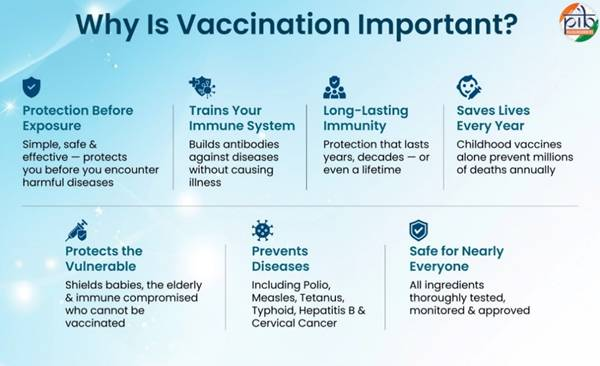
- Vaccination along with improvements in nutrition, sanitation, and healthcare, has significantly improved maternal and child survival rates in India.
- Full immunisation coverage increased from 62% (2015) to 98.4% (January 2026);
- Zero-dose children reduced from 0.11% (2023) to 0.06% (2024);
- Over 1.3 crore immunisation sessions conducted annually;
- Recognised globally as a model for large-scale public health delivery.
Government Initiatives
- The Universal Immunisation Programme: Launched in 1985 and implemented by the Ministry of Health and Family Welfare, it aims to provide free vaccines to children and pregnant women against various diseases.
- The programme reaches about 2.9 crore pregnant women and 2.54 crore newborns every year.
- Mission Indradhanush: It was launched in December 2014 by the Government of India to reach children and pregnant women who are unvaccinated or partially vaccinated.
- Recent Initiatives (2026)
- HPV Vaccination Campaign: Targets ~1.15 crore girls (14 years) for cervical cancer prevention.
- Indigenous Td Vaccine: Manufactured at CRI, Kasauli; ~55 lakh doses planned for supply.
- Digital Initiatives:
- eVIN: Real-time vaccine stock and temperature tracking;
- U-Win: Digital vaccination registry and tracking platform;
- CoWIN: Enabled administration of 220+ crore COVID vaccine doses.
Challenges
- Vaccine hesitancy and misinformation: Despite high coverage, pockets of resistance persist due to misinformation and cultural beliefs, contributing to the presence of zero-dose children (~0.06% in 2024), especially in certain regions.
- Last-mile delivery gaps: Reaching remote, tribal, and conflict-affected areas remains difficult, even though India conducts over 1.3 crore immunisation sessions annually under the UIP.
- Cold chain maintenance issues: India operates one of the largest vaccine cold chain systems with ~30,000 cold chain points and over 1.06 lakh equipment units, making uninterrupted temperature maintenance in difficult terrains a logistical challenge.
- Urban slum coverage gaps: High population mobility and informal settlements in urban areas lead to missed or partially immunised children, posing challenges for achieving universal coverage.
Source: PIB
Previous article
India’s Power Sector: Progress and Reforms
Next article
News In Short 19-03-2026
